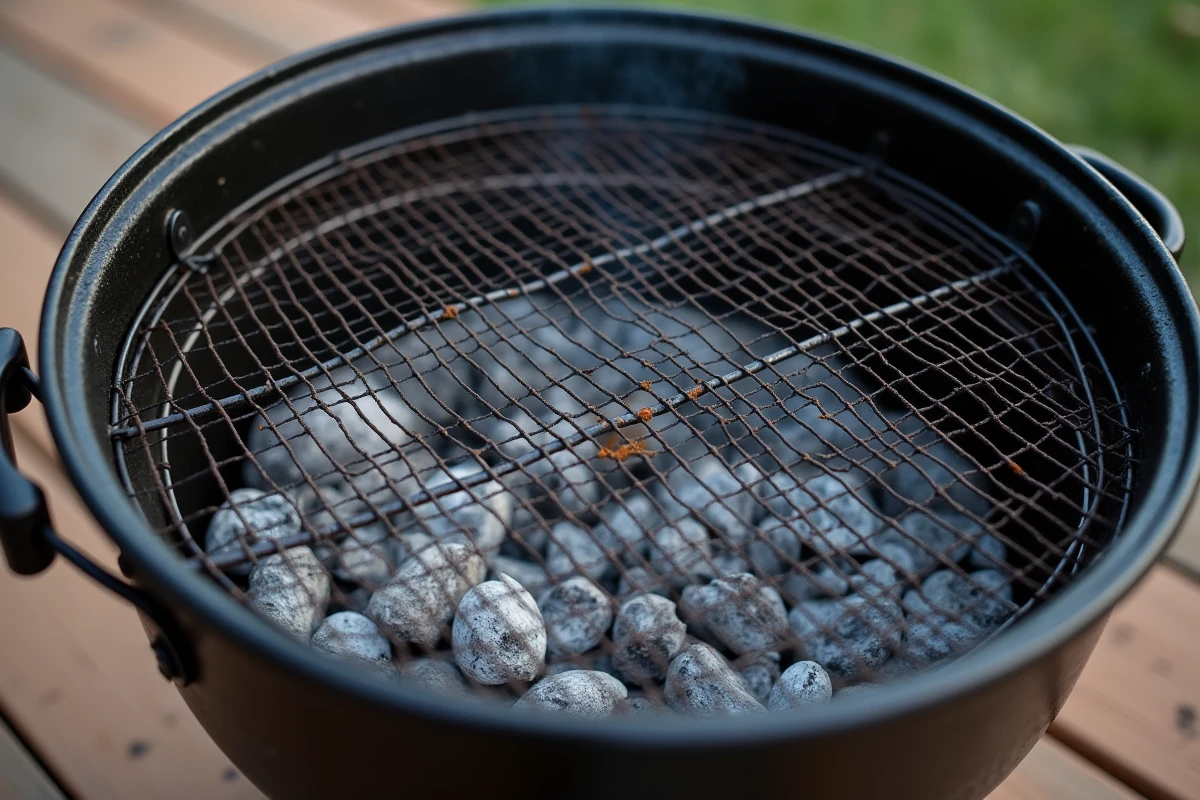
When you open a charcoal barbecue for the first time, a small grate placed at the bottom of the firebox rarely catches your attention. It seems accessory, almost decorative. However, this lower grate has a specific technical role that affects cooking quality, the longevity of the device, and ease of maintenance after each use.
Air circulation under the charcoal: the mechanism made possible by the grate
Have you noticed that some barbecues ignite easily while others struggle to produce decent embers? The difference often comes down to one detail: the presence or absence of a grate at the bottom of the firebox.
When the charcoal rests directly on the metal bottom, air does not circulate underneath. Combustion remains partial, slow, and produces more smoke. With a raised grate, even by a few centimeters, air enters through the lower vents and flows through the bed of charcoal. This upward flow feeds each ember evenly.
The result is quickly noticeable: the charcoal glows faster, the temperature rises more consistently, and cold spots in the firebox decrease. To understand in detail what the grate at the bottom of the barbecue is for, one must start from this principle of ventilation from below, common to all solid fuel appliances.
This mechanism also allows for better temperature control with the vents. Without a grate, opening or closing the air vents has little effect, since the charcoal suffocates against the flat bottom. With the grate, each vent adjustment truly alters the airflow and thus the intensity of the fire.

Ash and moisture: how the grate protects the barbecue firebox
Over the course of cooking, the charcoal burns down and produces a significant amount of ash. Without a lower grate, these residues accumulate around the still-active embers and form a compact layer.
The ashes retain ambient moisture, especially at the end of the day or in overcast weather. This ash-moisture mixture remains pressed against the metal of the firebox for hours, sometimes days if the barbecue is not cleaned immediately.
The resulting corrosion attacks the bottom of the barbecue much faster than one might think. The perforated or deformed fireboxes found after a few seasons often result from this prolonged contact between damp ashes and metal.
The grate creates a buffer space. The ashes fall below, detach from the active charcoal, and can be easily removed via the ashtray or by removing the grate after cooling. Separating the ashes from the active charcoal significantly extends the lifespan of the firebox.
Fixed grate or removable grate: a choice that changes maintenance
Not all barbecues offer the same type of lower grate. There are two main categories, and the ease of use differs significantly between the two.
Fixed grate welded to the firebox
Some entry-level models feature a grate directly welded to the bottom of the bowl. It serves its ventilation function, but cleaning becomes cumbersome. You have to scrape the residues through the bars without being able to remove the grate.
Removable grate on supports
Mid-range and high-end barbecues use a grate placed on edges or notches. It can be removed in seconds to empty the ashes, brush it, or replace it if it wears out.
Here are the criteria to check before buying or replacing a bottom grate:
- The material: enameled steel withstands heat and corrosion better than untreated raw steel, which rusts from the first season
- The diameter or exact dimensions: a grate that is too small allows charcoal to fall through the sides and negates the ventilation effect
- The spacing of the bars: if too wide, the charcoal falls through; if too tight, the ashes do not evacuate properly
Direct and indirect cooking: the discreet role of the lower grate
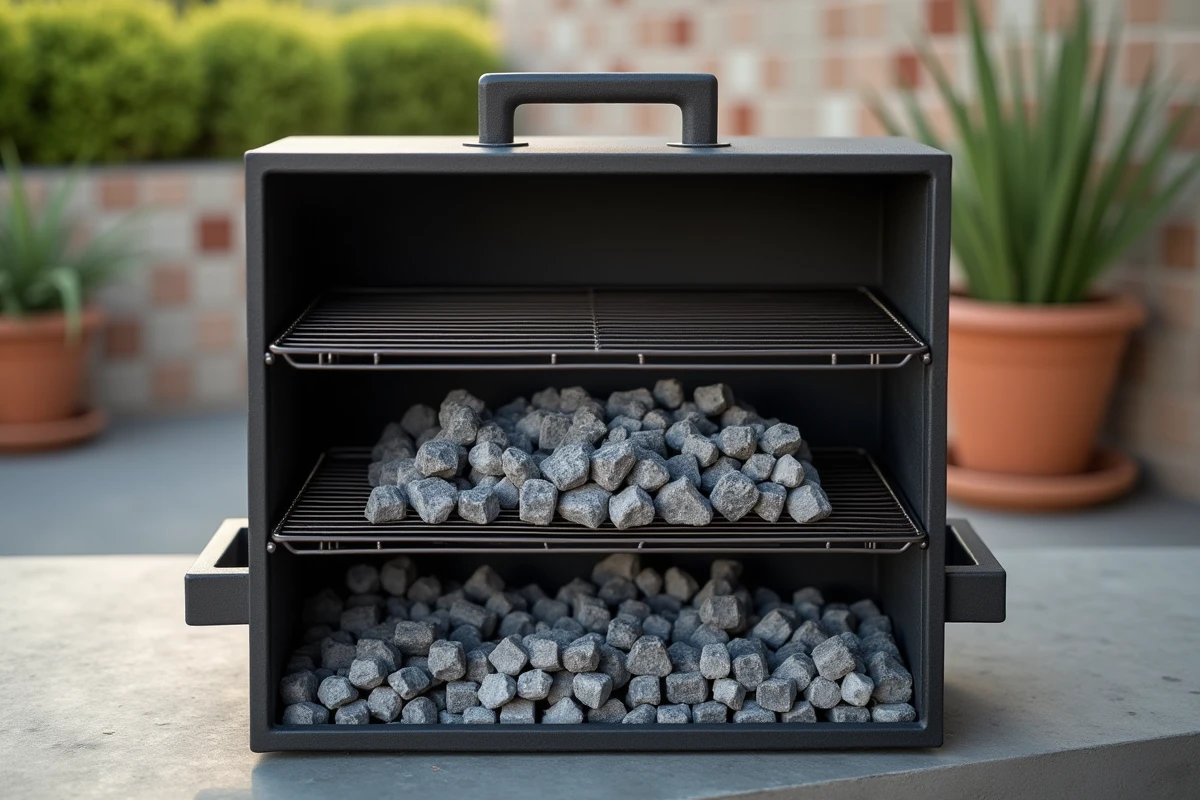
The grate at the bottom of the barbecue is not only there to passively support the charcoal. It also plays a role in the indirect cooking technique, which is widely used for thick cuts of meat or whole poultry.
In indirect cooking, the embers are placed on one side of the firebox. The lower grate allows the charcoal to remain elevated and well-ventilated even in an off-center configuration. Without it, the embers pushed to the side pile up against the wall, burn unevenly, and lose intensity.
For classic direct cooking (grilling, sausages, steaks), the bottom grate ensures a more even distribution of heat. The charcoal does not sink into its own ashes after half an hour, which maintains a stable temperature for longer.
Maintenance of the bottom grate after each barbecue season
The lower grate undergoes repeated thermal stress. Between the intense heat of the embers and the sudden cooling when the barbecue is opened, the metal works with each use.
A few simple gestures are enough to keep it in good condition:
- Remove the ashes after each cooking, once the barbecue has cooled, to avoid prolonged contact with moisture
- Brush the grate with a soft-bristled metal brush, without aggressive chemical products that could damage the coating
- Check the grate at the beginning of the season: a warped grate or one with rust-thinned bars no longer fulfills its support and ventilation function properly
- Store the barbecue in a sheltered place or use a cover, as the bottom grate is the first part exposed to the elements when the lid is not perfectly sealed
Replacing a worn bottom grate costs little compared to replacing an entirely corroded firebox. It is a maintenance investment that pays off over several seasons.
The grate at the bottom of the barbecue remains a discreet component, but every function it fulfills (ventilation, separation of ashes, stable support for charcoal) has a measurable effect on the quality of grilling and the longevity of the device. Checking its condition before the next season takes two minutes and can change the outcome of an entire cooking session.