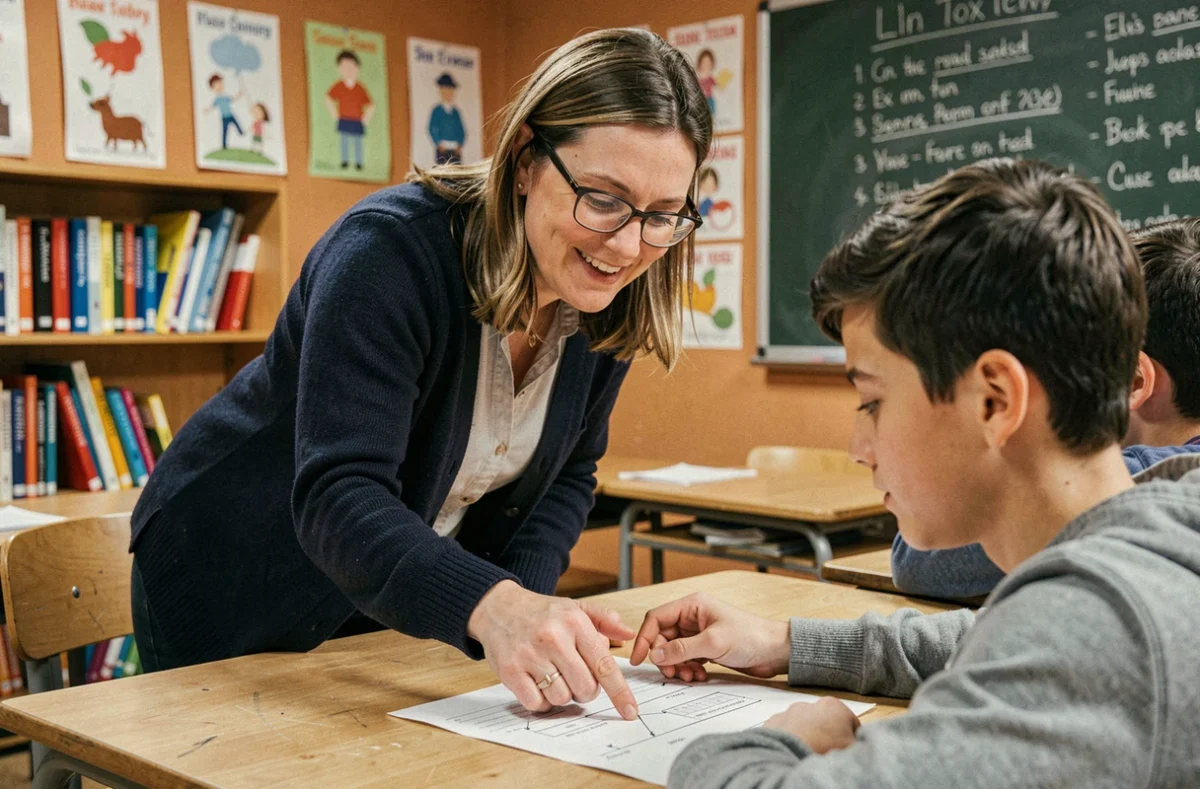
A fifth-grade student is stuck on a proportionality problem. The teacher reformulates the instructions, changes the material, and proposes a diagram. Nothing works until an interactive exercise with visual manipulation unlocks understanding in a few minutes. This kind of situation is encountered in every classroom. It raises a direct question: how to choose and organize educational resources so that they truly meet the needs of each student?
National assessments and adaptation of materials: the persistent gap
Since the start of the 2025 school year, national benchmark assessments (CP, CE1, CE2, CM1, CM2) are no longer used solely to provide an end-of-period report. They are increasingly used to trigger rapid pedagogical differentiation as soon as needs are identified. The idea is simple: do not wait for the class council to make adjustments.
On the ground, the observation remains mixed. According to an evaluation by the Ministry of National Education regarding French and mathematics teaching in sixth and fifth grades, the adaptation of materials is still unevenly implemented in classrooms. Teachers find it easier to adjust their questioning practices than the resources themselves. In other words, different questions are asked, but the same document is often distributed to everyone.
It is in this gap that concrete work on educational resources makes perfect sense. An exercise sheet adapted in font, layout, or level of difficulty does not require an excessive investment, but it does assume access to tools designed for that purpose. One can rely on the educational resources from Com Unic to structure this adaptation process without starting from scratch for each sequence.
Differentiated resources in French and mathematics in middle school: what changes concretely
Pedagogical support in middle school is becoming more flexible. The announced changes for the 2026 school year pave the way for combinations of temporary groups, targeted support, and co-intervention. We are no longer just talking about fixed ability groups, but about modular systems adapted to the pace of students’ progress.
In practice, this means that a student struggling with text comprehension can join a small group for three weeks and then reintegrate their class once the blockage is lifted. For this system to work, ready-to-use resources calibrated by objective are needed.
What this implies for preparing sequences
A teacher managing three levels of need in the same class cannot design three distinct lessons every night. Differentiation relies on reusable modular materials: graded exercises, reformulated instructions, visual aids integrated into the student document.
Feedback varies on this point: some teams find these tools easy to integrate, while others consider them time-consuming to implement without support. The key is often collaboration. When a colleague shares an adapted exercise that worked, time is saved, and there is no need to reinvent the wheel.
- Exercises with progressive difficulty, with a common base and extensions for advanced students
- Instruction sheets reformulated in simplified language, usable independently by the student
- Visual supports (diagrams, mind maps) associated with key concepts of the French and mathematics curriculum
Artificial intelligence and personalized support: where to draw the line
The design of educational resources is beginning to incorporate AI-based assistants. Generation of exercises, automatic reformulation of instructions, suggestions for individualized pathways: the technical possibilities exist. The CNP Assurances Foundation mentioned in its 2025 activity report the launch of initiatives in this area.
The challenge does not lie in the technology itself. The quality of human support remains the determining factor. A tool that generates twenty variants of an exercise is useless if the teacher does not know which one to assign to which student profile. AI can accelerate the production of materials, but the pedagogical decision remains in the classroom.
Criteria for evaluating a digital resource before adoption
Before switching to a new tool, it is beneficial to check a few concrete points rather than relying on marketing promises.
- Does the resource allow for a real adaptation of the level of difficulty, or does it offer a unique pathway dressed differently?
- Does the teacher retain control over the choice of content and progression, or does the algorithm decide alone?
- Is the time required for familiarization compatible with regular use in class, without heavy training?
- Are the student data collected compliant with GDPR and hosted in France?
Student’s personal work and autonomy: structuring without overloading
Personal work remains an underutilized lever. Assigning homework is not enough: the student must also know how to approach it. In many classrooms, it is observed that students in difficulty lack method rather than will.
Structuring personal work involves simple tools. A memorization sheet with questions and answers, a weekly work plan with short objectives, a tracking notebook where the student notes what they have understood and what is blocking them. These supports, when well-designed, foster autonomy without adding cognitive load.
Collaboration between parents and teachers also plays a role. A parent who understands the objective of an exercise can better support their child at home. Clear instructions on the homework sheet, a note explaining the targeted skill: these details change the dynamics of homework.
Supporting a student towards success is not about multiplying initiatives. It is about articulating adapted resources, an evaluation that guides action, and regular human follow-up. The most effective approach is often the simplest: a well-targeted support, offered at the right time, with prompt feedback from the teacher on what the student has produced.