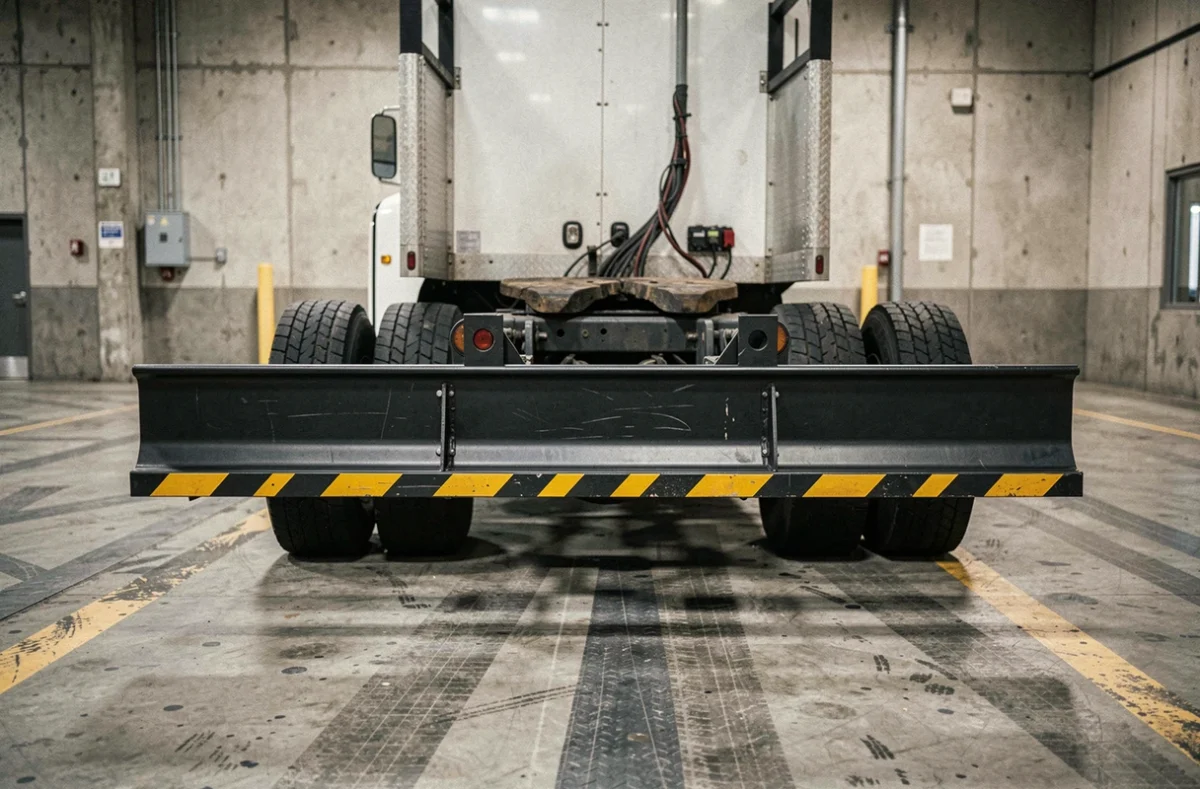
Have you ever noticed that metal bar fixed under the rear of heavy trucks? It’s not a bumper. It’s an anti-intrusion bar, a safety device designed to prevent a car from sliding under the chassis of a truck during a rear collision. Without it, the cabin of a light vehicle would go directly under the trailer, often with fatal consequences. Regulations strictly govern these devices, but several points remain poorly understood by operators and bodybuilders.
Liftgate and anti-intrusion bar: a common confusion
On many trucks equipped with a liftgate, no distinct metal crossmember is visible at the rear. This is normal: the liftgate can serve as an anti-intrusion device when in road position. The ECE-R58 regulation allows this, provided that the liftgate, its supports, and its locking system meet the same strength requirements as a dedicated bar.
This subtlety creates a trap. A poorly locked or partially raised liftgate while driving no longer offers protection. The supports must withstand the same forces as a traditional steel crossmember. During technical inspection or vehicle reception, the entire assembly is evaluated, not just the physical presence of an obstacle at the rear.
To learn everything about truck anti-intrusion bars, it is essential to consider the equipment in its actual configuration of use, including the liftgate.
ECE-R58 Regulation: what the standard concretely imposes
The ECE-R58 regulation (in its revision R58-03) sets the technical criteria applicable to rear anti-intrusion bars. Two parameters determine the compliance of a bar: the maximum height from the ground (dimension G, measured empty) and the protection dimension P, which corresponds to the horizontal distance between the bar tube and the end of the bodywork.

Dimension G varies according to the type of suspension of the vehicle. Dimension P depends on the category of the vehicle (truck, trailer, semi-trailer). Each model of bar has its own values, indicated in the manufacturer’s documentation.
The choice of a model is made by cross-referencing dimensions A and B of the chassis, then checking that dimension P and height G remain within regulatory limits. It is not a universal part: a perfectly compliant bar on a truck may be unsuitable on a semi-trailer due to differences in ground clearance or overhang.
Dump trucks: the special case of liftable bars
On dump trucks or vehicles with mobile equipment, the bar often needs to be lifted to allow tilting or unloading. Manual lift models exist for this reason. The bar must be in the lowered position whenever the vehicle is on public roads.
A compliant bar in its normal position becomes ineffective if it remains raised during a journey. The locking device in the lowered position is an integral part of the reception control. This is a point that drivers must check during their daily inspection, just like lighting or securing the load.
Installation of an anti-intrusion bar: errors that invalidate compliance
Installing an approved bar is not enough to make the vehicle compliant. The installation itself can compromise the whole if not done according to the rules. Here are the critical points:
- The attachment to the chassis beams must comply with the manufacturer’s specifications, particularly regarding the size and quality of the screws. The rigidity module of the beams varies according to the bar references.
- Installing a liftgate, hitch, or hydraulic equipment nearby can alter ground clearance, visibility of the license plate, or access to the rear lighting. A correctly sized bar in isolation may remain non-compliant once mounted on the vehicle.
- The interfaces between the bar and other chassis elements (light supports, cable passages, hitch) must be checked globally during the reception of the bodied vehicle.
The bodybuilder is responsible for this overall verification. It is not just about bolting a crossmember but ensuring that the integration meets all regulatory constraints simultaneously.
Control and documentation: do not rely on old catalogs
The commercial documents of bar manufacturers evolve with regulatory revisions. A catalog from a few years ago may no longer reflect current requirements. Revision R58-03 introduced stricter criteria than previous versions.
To verify the compliance of a bar, several elements must be gathered:
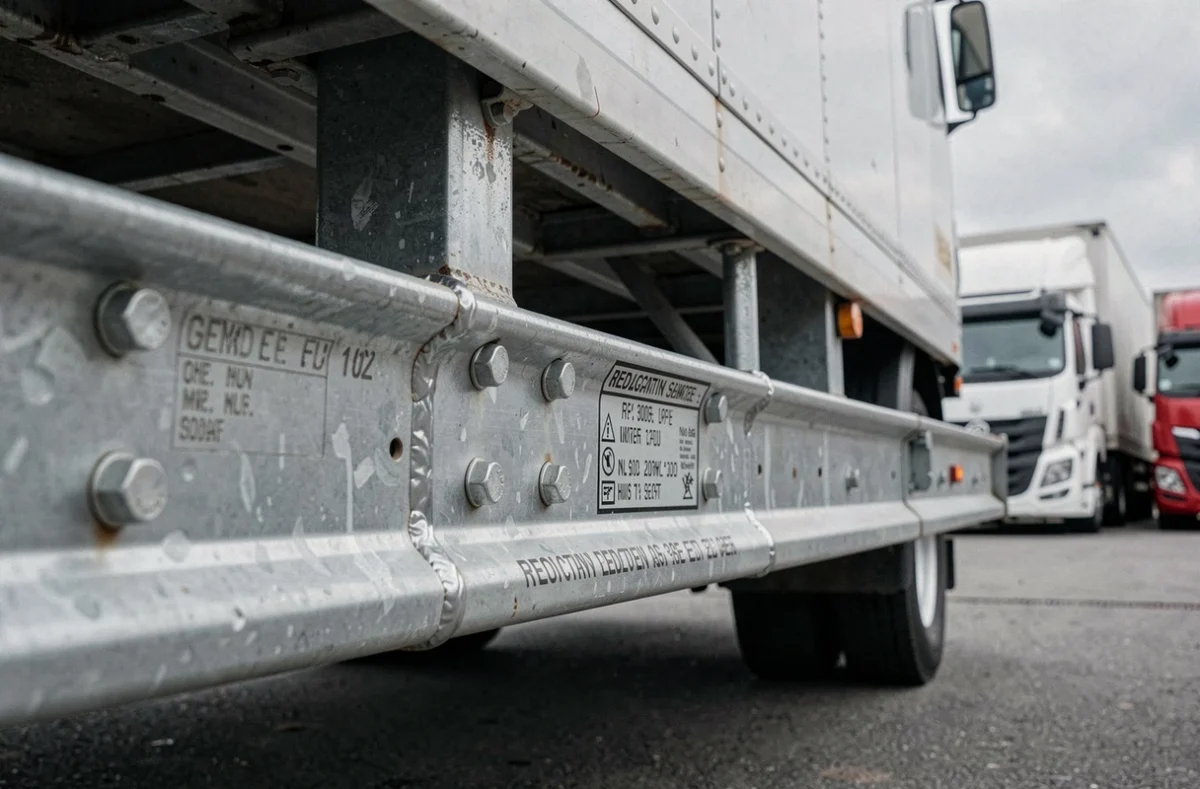
- The approval marking on the bar itself, with the revision number of the applicable regulation.
- The installation manual provided by the manufacturer, which specifies the installation conditions, required fasteners, and usage limits.
- The reception report of the bodied vehicle, certifying that the whole (bar, chassis, peripheral equipment) is compliant.
Always check the revision of the regulation mentioned on the marking before validating an installation. A bar approved under an old revision may no longer be accepted during a recent technical inspection.
Daily inspection by the driver
Responsibility does not stop at installation. The driver must check before each departure that the bar is in the lowered position and properly locked. On liftable models, a faulty lock or forgetting to return it to position constitutes an offense and, above all, a deadly risk for users following the vehicle.
The anti-intrusion bar remains one of the simplest protection devices on a heavy truck, but its compliance depends on a complete chain: choosing the model suitable for the chassis, mounting according to specifications, checking the entire bodied vehicle, and then regular control during operation. Every link counts, from the bodybuilder to the driver.